Postings

DOWNLOADS

Emergency Flip ChartWolfAlertMedical/AED/First AidWeather / Adverse ConditionsFire / Life SafetyDisabilitiesHazardous MaterialUtility FailureActive ShooterEmergency PreparednessTransportationSuspicious Person
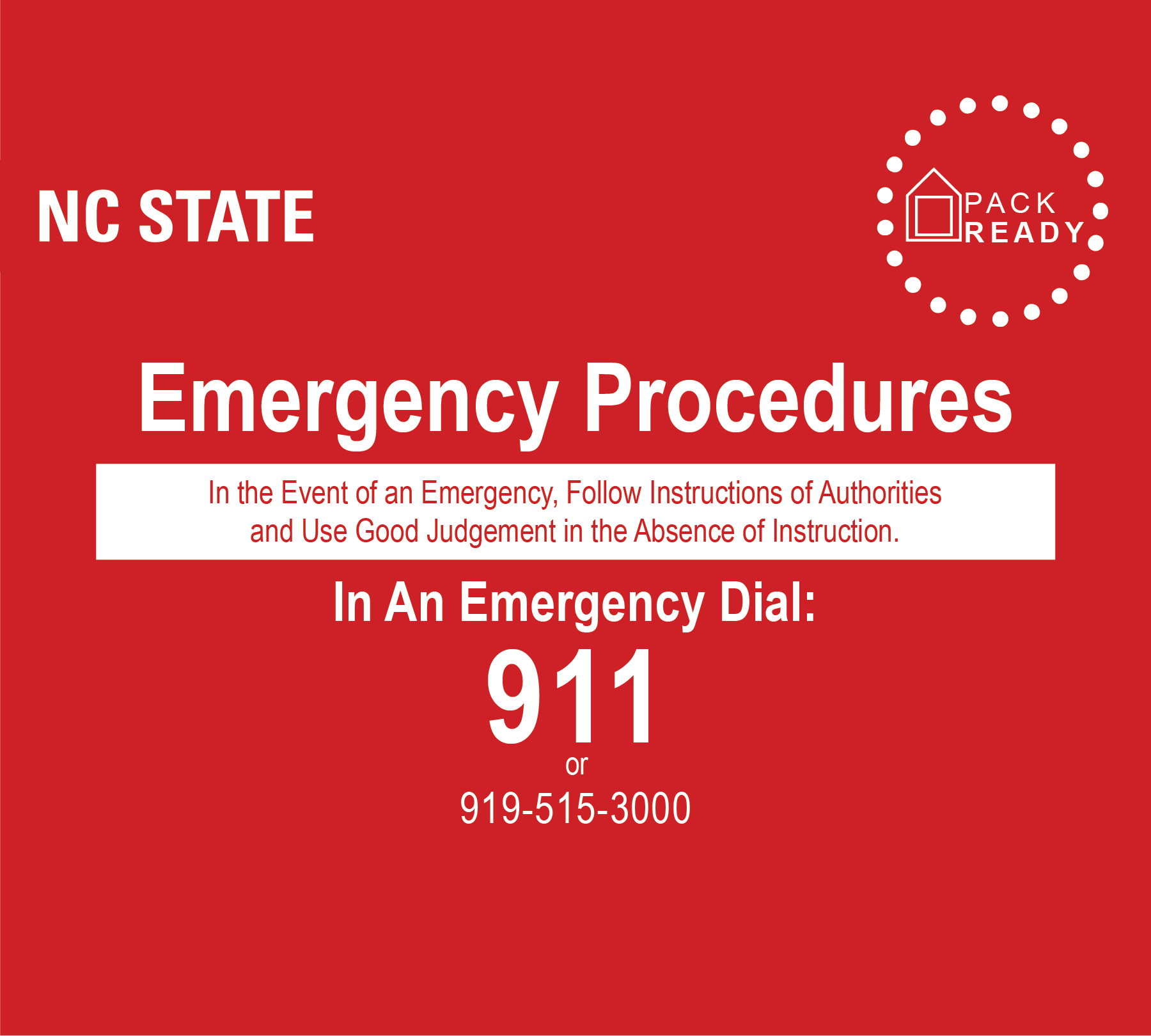
Emergency Procedures, In the event of an emergency, follow instructions of authorities and use good judgement in the absence of Instruction. In an Emergency Dial 911 or 9195153000.

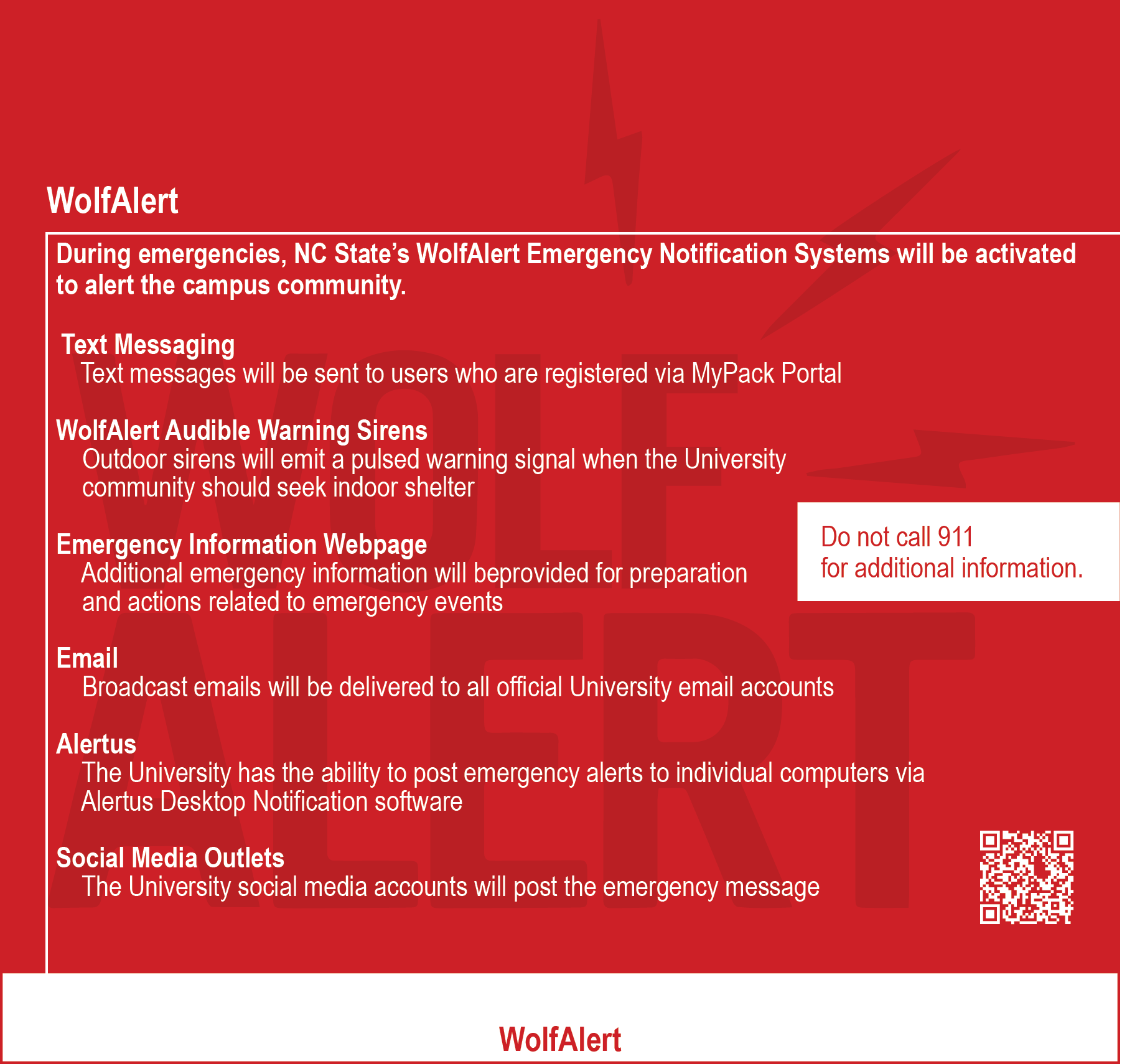
WolfAlert. During Emergencies, NC State's WolfAlert Emergency Notification Systems will be activated to alert the campus community. Text messaging will be sent to users who are registered via MyPack Portal. WolfAlert Audible Warning Sirens, Outdoor sirens will emit a pulsed warning signal when the University community should seek indoor shelter. Emergency Information Webpage, additional emergency information will be provided for preparation and actions related to emergency events. Email, broadcast email will be delivered to all official university email accounts. Alertus, the university has the ability to post emergency alerts to individual computers via Alertus Desktop Notification software. Social Media Outlets, the university social media accounts will post the emergency message. Do not call 911 for additional information.

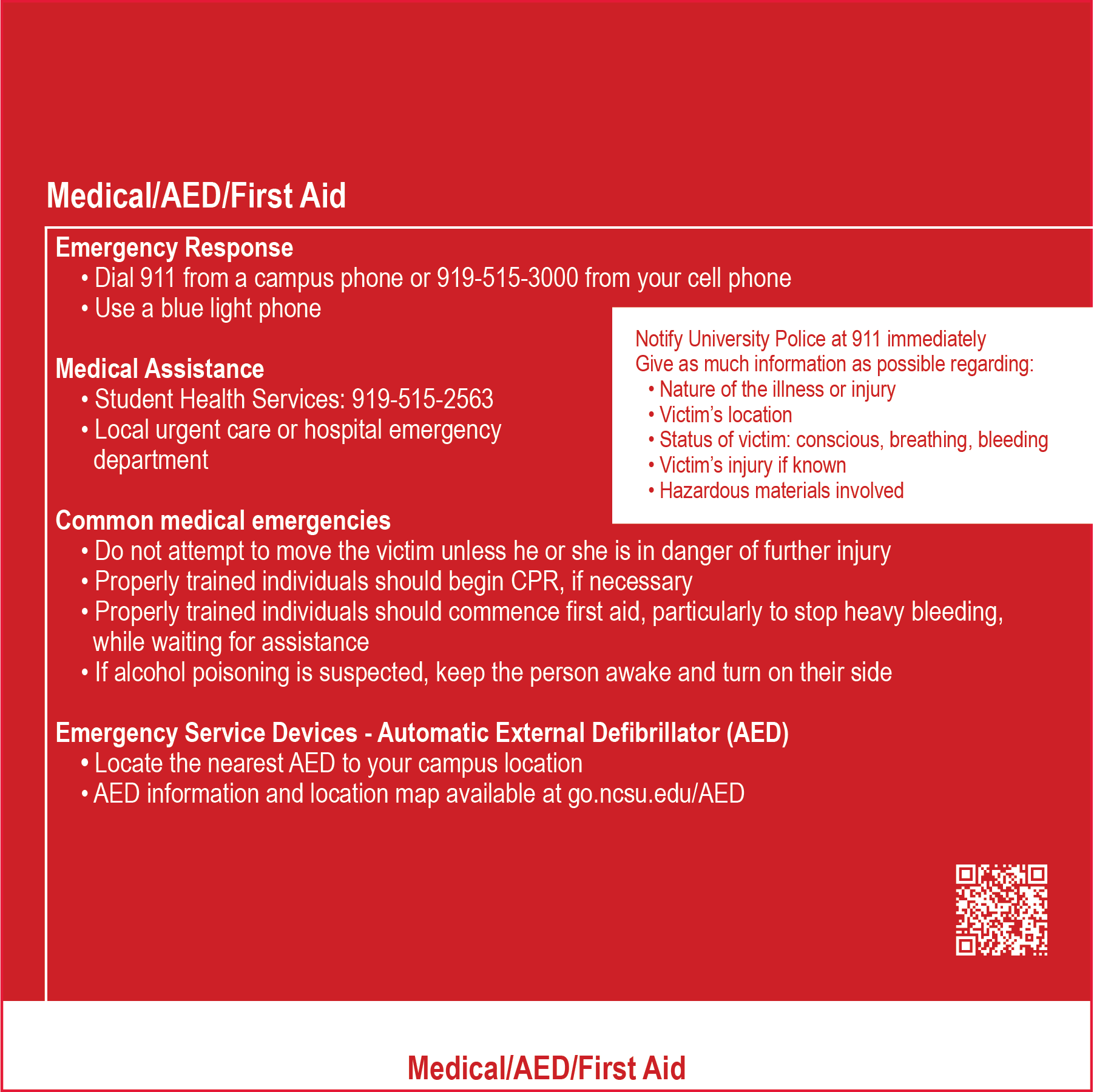
Medical/AED/First Aid. Emergency Response; Dial 911 from a campus phone or 9195153000 from your cell phone, use a blue light phone. Medical Assistance; student health services phone number 9195152563, local urgent care or hospital emergency department. Common medical emergencies; do not attempt to move the victim unless he or she is in danger of further injury, properly trained individuals should begin CPR if necessary, properly trained individuals should commence first aid, particularly to stop heavy bleeding, while waiting for assistance, if alcohol is suspected, keep the person aware and turn them on their side. Emergencies service devices - automatic external defibrillator (AED); locate the nearest AED to your campus location, AED information and location map available at go.ncsu.edu/AED. Notify University Police at 911 immediately and give as much information as possible regarding: Nature of illness or injury, Victim's location, status of victim (e.g. conscious, breathing, bleeding), victim's injury if known, hazardous materials involved.

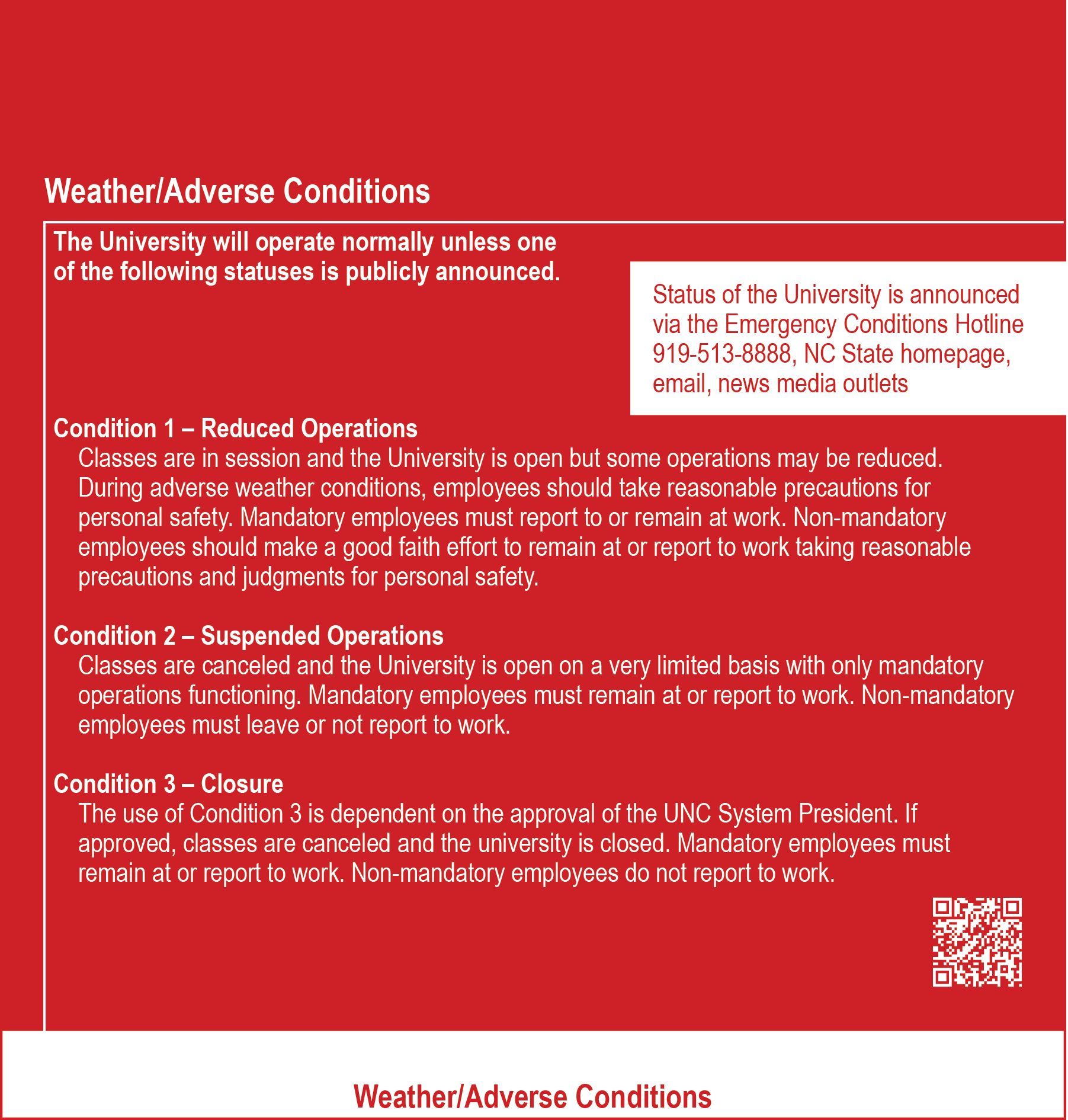
Weather/Adverse Conditions. Status of the university is announced via the emergency conditions hotline at 9195138888, NC State homepage, email, news media outlets. The University will operate normally unless one of the following statuses is publicly announced. Condition 1: Reduced operations. Classes are in session and the university is open but some operations may be reduced. During adverse weather conditions, employees should take reasonable precautions for personal safety. Mandatory employees must report to or remain at work. Non-mandatory employees should make a good faith effort to remain at or report to work taking reasonable precautions and judgements for personal safety. Condition 2 - Suspended operations. Classes are cancelled and the university is open on a very limited basis with only mandatory operations functioning. Mandatory employees must remain at or report to work. Non-mandatory employees must leave or not report to work. Condition 3 - Closure. The use of Condition 3 is dependent on the approval of the UNC System President. If approved, classes are cancelled and the University is closed. Mandatory employees must remain at or report to work. Non-mandatory employees do not report to work.

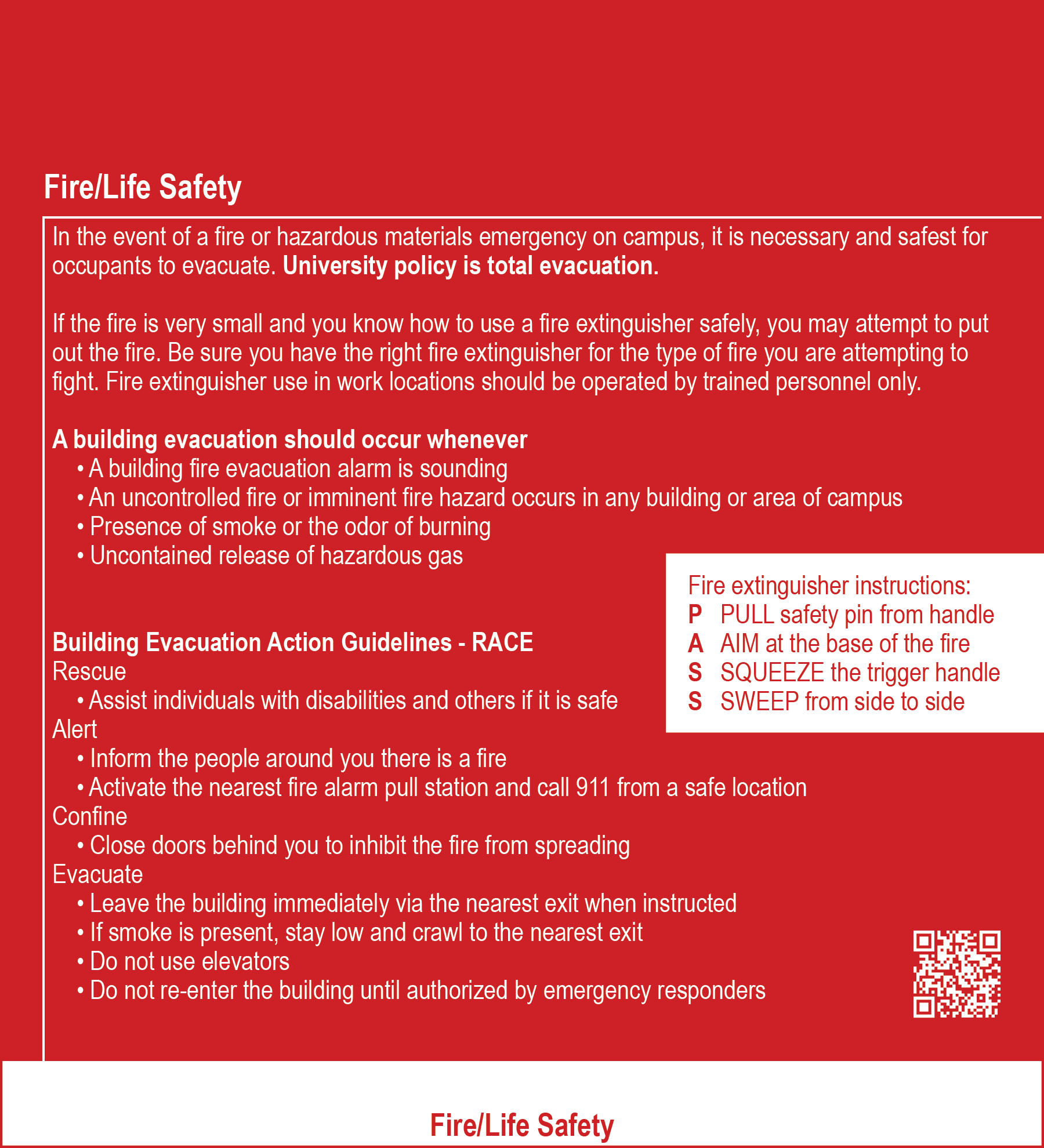
Fire/life safety. In the event of a fire or hazardous materials emergency on campus, it is necessary and safest for occupants to evacuate. University policy is total evacuation. If the fire is very small and you know how to use a fire extinguisher safely, you may attempt to put out the fire. Be sure you have the right fire extinguisher for the type of fire you are attempting to fight. Fire extinguisher use in work locations should be operated by trained personnel only. A building evacuation should occur whenever a building fire evacuation alarm is sounding, an uncontrolled fire or imminent fire hazard occurs in any building or area of campus, presence of smoke or the odor of burning, uncontained release of hazardous gas. Building evacuation Action Guidelines - R.A.C.E. - Rescue - Assist individuals with disabilities and others if it is safe. Alert - Inform the people around you there is a fire, activate the nearest fire alarm pull station and call 911 from a safe location. Confine - Close the doors behind you to inhibit the fire from spreading. Evacuate - Leave the building immediately via the nearest exit when instructed, if smoke is present, stay low and crawl to the nearest exit, do not use elevators, do not re-enter the building until authorized by emergency responders. Fire extinguisher instructions: PASS; P - Pull safety pin from handle, A - Aim at the base of the fire, S - Squeeze the trigger handle, S - Sweep from side to side.

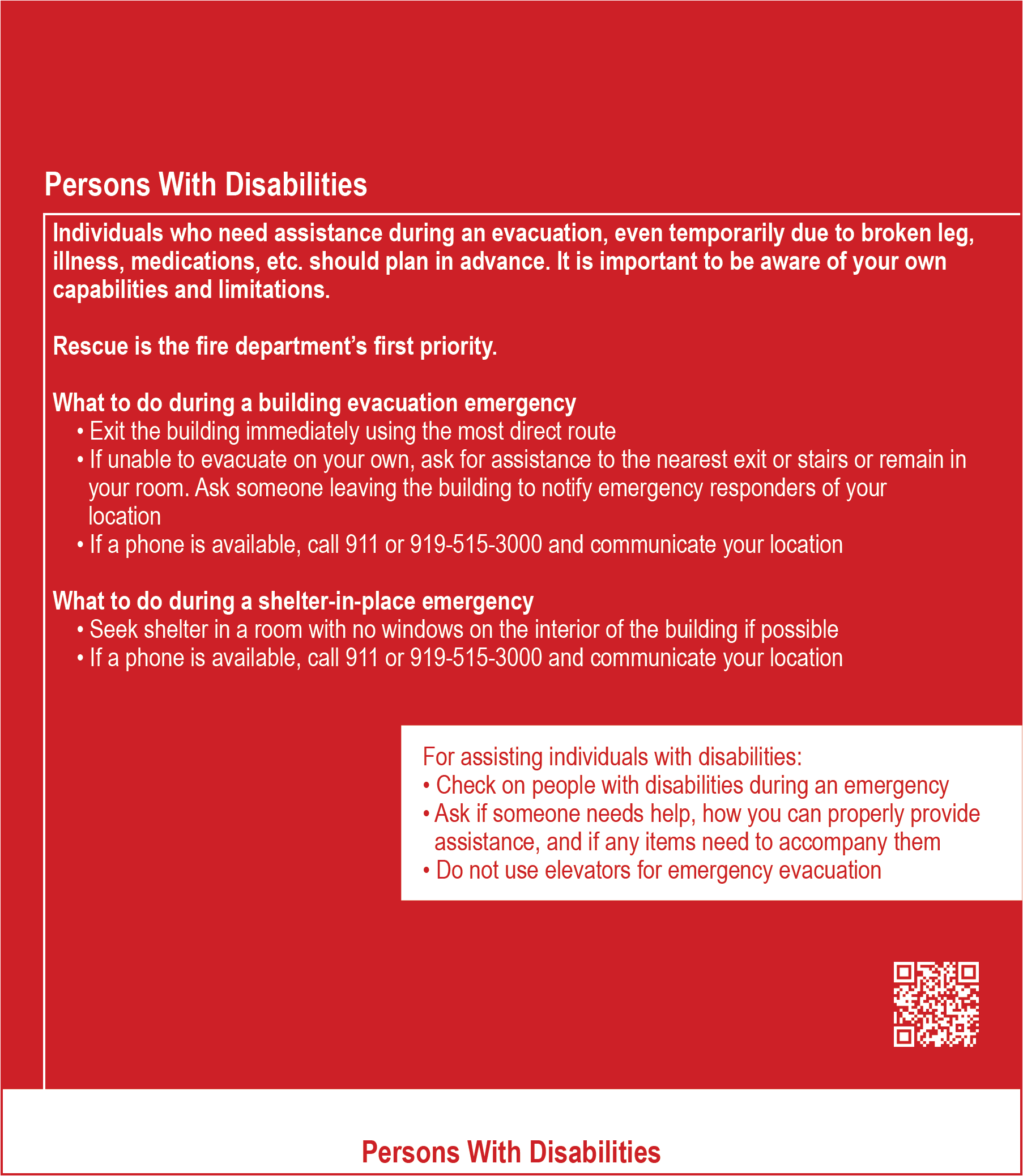
Persons With Disabilities. Individuals who need assistance during an evacuation, even temporarily due to broken leg, illness, medications, etc. should plan in advance. It is important to be aware of your own capabilities and limitations. Rescue is the fire department's first priority. What to do during a building evacuation emergency; Exit the building immediately using the most direct route; If unable to evacuate on your own, ask for assistance to the nearest exit or stairs or remain in your room. Ask someone leaving the building to notify emergency responders of your location. If a phone is available, call 911 or 9195153000 and communicate your location. What to do during a shelter-in-place emergency; Seek shelter in a room with no windows on the interior of the building if possible; If a phone is available, call 911 or 9195153000 and communicate your location. For assisting individuals with disabilities: Check on people with disabilities during an emergency; Ask if someone needs help, how you can properly provide assistance, and if any items need to accompany them; Do not use elevators for emergency evacuation.

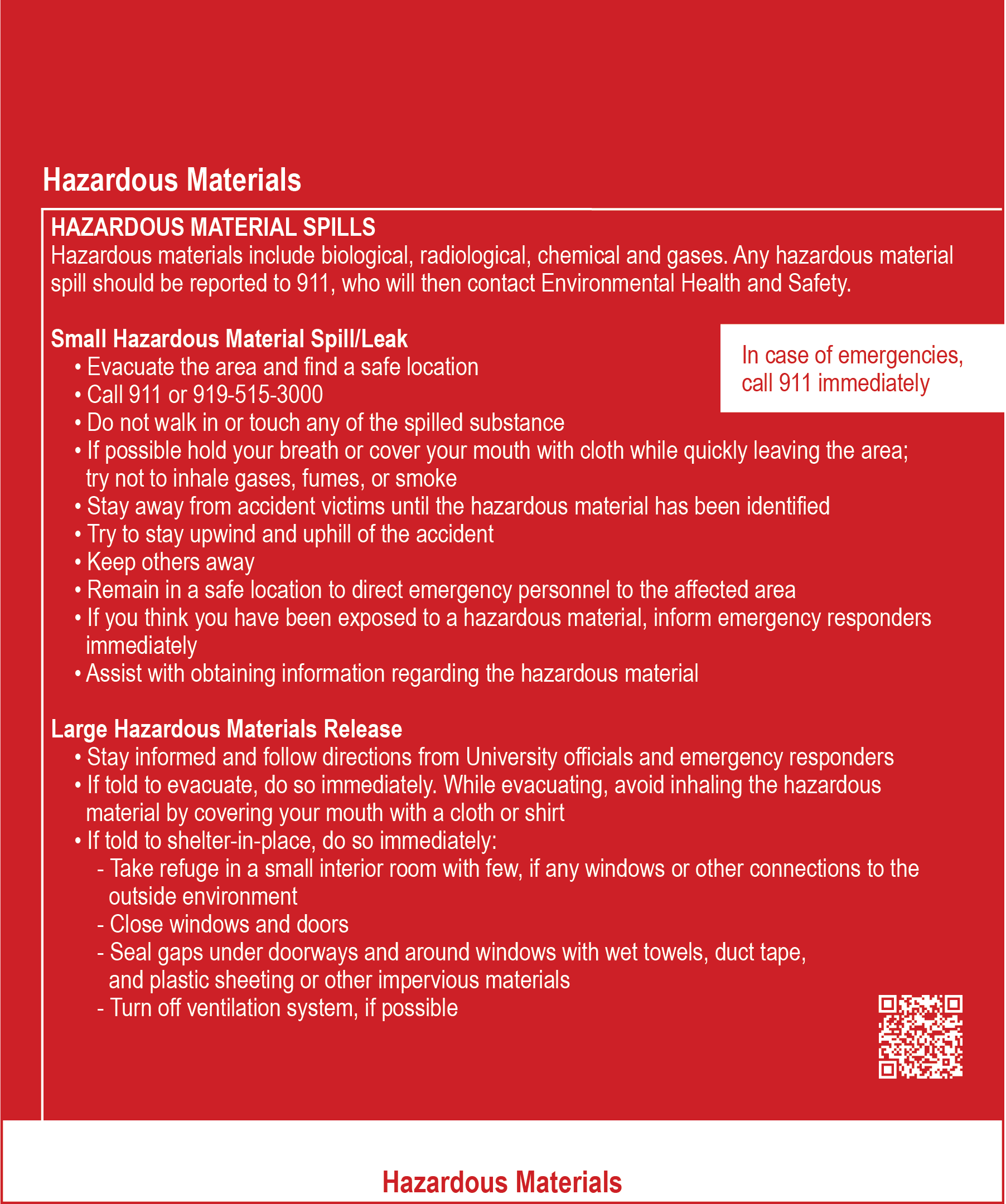
Hazardous Materials. HAZARDOUS MATERIAL SPILLS; Hazardous materials include biological, radiological, chemical and gases. Any hazardous material spill should be reported to 911, who will then contact Environmental Health and Safety. Small Hazardous Material Spill/Leak; Evacuate the area and find a safe location; Call 911 or 9195153000; Do not walk in or touch any of the spilled substance; If possible hold your breath or cover your mouth with cloth while quickly leaving the area; try not to inhale gases, fumes, or smoke; Stay away from accident victims until the hazardous material has been identified; Try to stay upwind and uphill of the accident; Keep others away; Remain in a safe location to direct emergency personnel to the affected area; If you think you have been exposed to a hazardous material, inform emergency responders immediately; Assist with obtaining information regarding the hazardous material. Large Hazardous Materials Release; Stay informed and follow directions from University officials and emergency responders; If told to evacuate, do so immediately. While evacuating, avoid inhaling the hazardous material by covering your mouth with a cloth or shirt; If told to shelter-in-place, do so immediately: Take refuge in a small interior room with few, if any windows or other connections to the outside environment; Close windows and doors; Seal gaps under doorways and around windows with wet towels, duct tape, and plastic sheeting or other impervious materials; Turn off ventilation system, if possible. In case of emergencies, call 911 immediately.

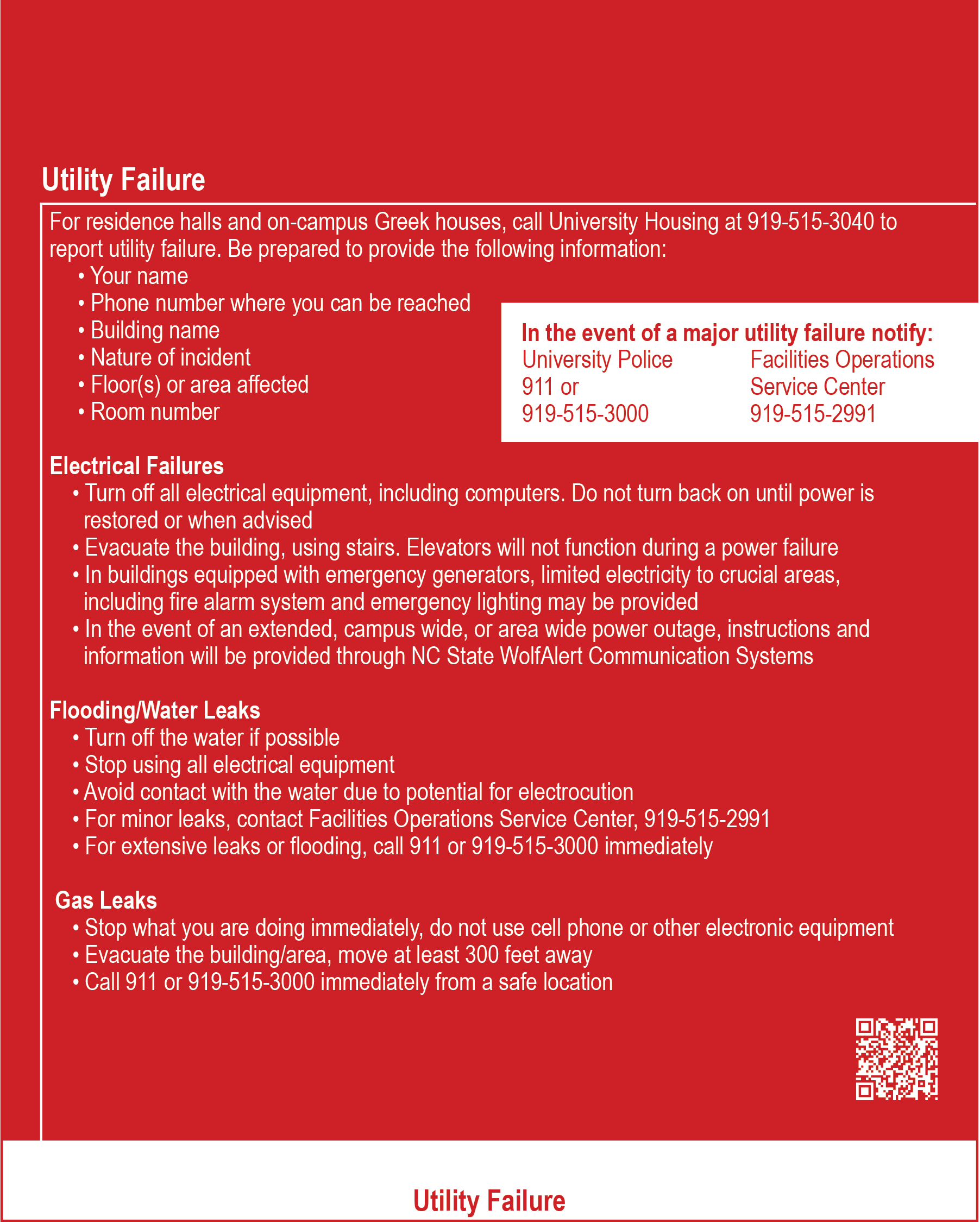
Utility Failure. For residence halls and on-campus Greek houses, call University Housing at 9195153040 to report utility failure. Be prepared to provide the following information: Your name, Phone number where you can be reached, Building name, Nature of incident, Floor(s) or area affected, Room number. In the event of a major utility failure notify: University Police at 911 or 9195153000, Facilities Operations Service Center 9195152991. Electrical Failures; Turn off all electrical equipment, including computers. Do not turn back on until power is restored or when advised. Evacuate the building, using stairs. Elevators will not function during a power failure. In buildings equipped with emergency generators, limited electricity to crucial areas, including fire alarm system and emergency lighting may be provided. In the event of an extended, campus wide, or area wide power outage, instructions and information will be provided through NC State WolfAlert Communication Systems. Flooding/Water Leaks; Turn off the water if possible; Stop using all electrical equipment; Avoid contact with the water due to potential for electrocution; For minor leaks, contact Facilities Operations Service Center, 9195152991, For extensive leaks or flooding, call 911 or 9195153000 immediately, Gas Leaks; Stop what you are doing immediately, do not use cell phone or other electronic equipment. Evacuate the building/area, move at least 300 feet away. Call 911 or 9195153000 immediately from a safe location.

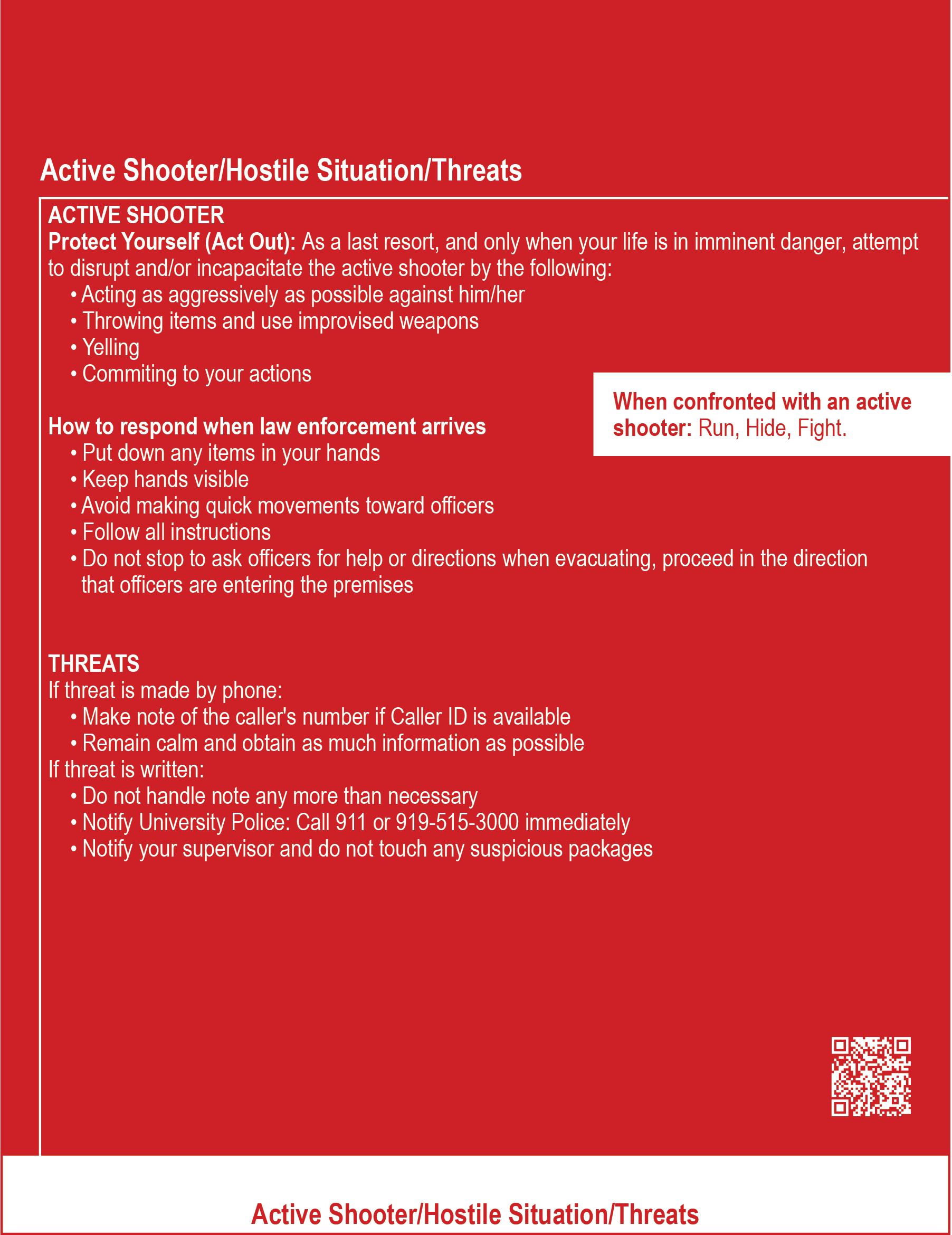
Active Shooter/Hostile Situation/Threats. ACTIVE SHOOTER; Protect Yourself (Act Out): As a last resort, and only when your life is in imminent danger, attempt to disrupt and/or incapacitate the active shooter by the following: Acting as aggressively as possible against him/her; Throwing items and use improvised weapons; Yelling; Committing to your actions. How to respond when law enforcement arrives; Put down any items in your hands; Keep hands visible; Avoid making quick movements toward officers; Follow all instructions; Do not stop to ask officers for help or directions when evacuating, proceed in the direction that officers are entering the premises. THREATS; If threat is made by phone: Make note of the caller's number if Caller ID is available; Remain calm and obtain as much information as possible. If threat is written: Do not handle note any more than necessary; Notify University Police: Call 911 or 9195153000 immediately; Notify your supervisor and do not touch any suspicious packages. When confronted with an active shooter: Run, hide, fight.

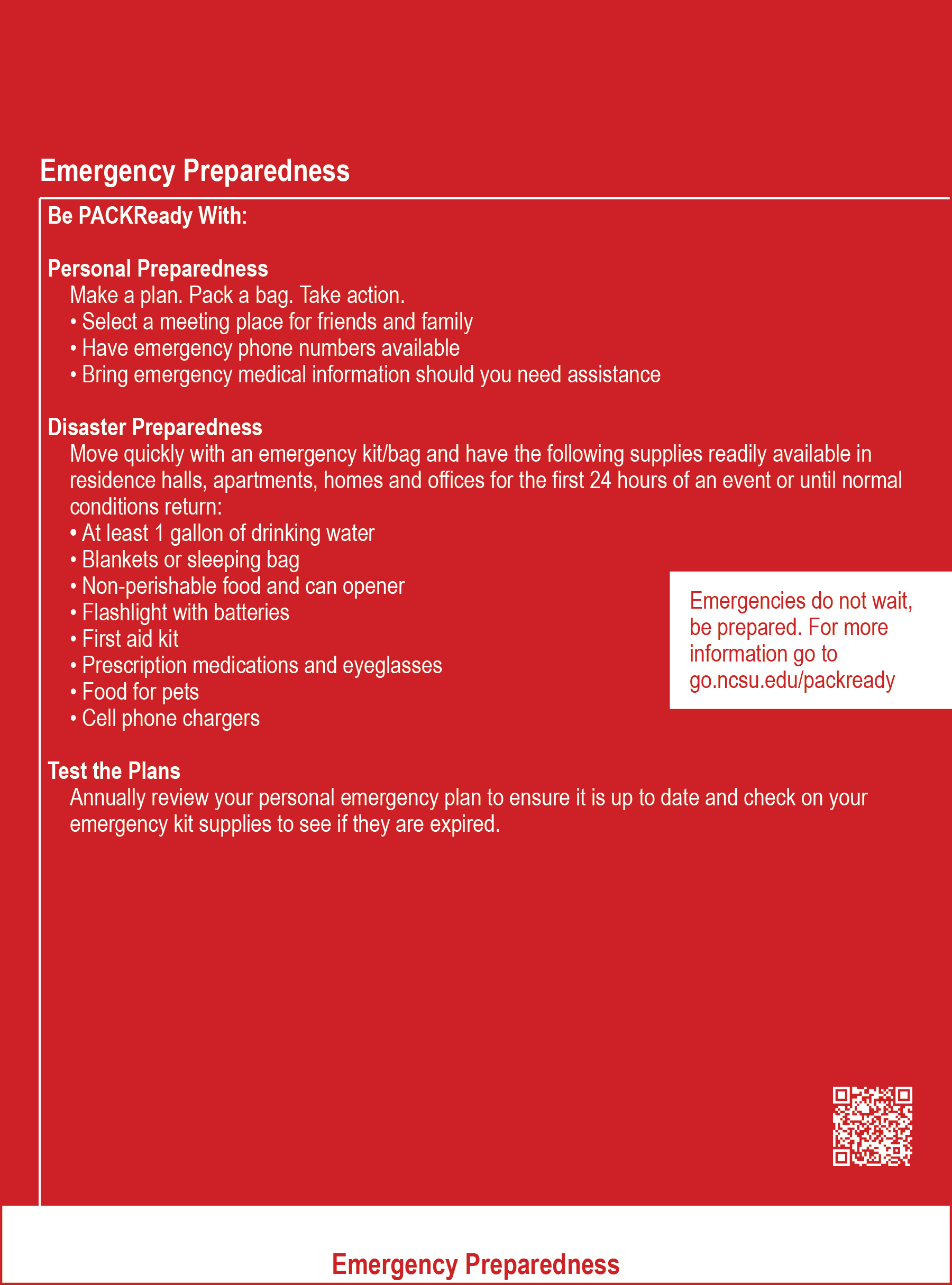
Emergency Preparedness. Be PACKReady With: Personal Preparedness; Make a plan. Pack a bag. Take action. Select a meeting place for friends and family, Have emergency phone numbers available, Bring emergency medical information should you need assistance. Disaster Preparedness; Move quickly with an emergency kit/bag and have the following supplies readily available in residence halls, apartments, homes and offices for the first 24 hours of an event or until normal conditions return: At least 1 gallon of drinking water, Blankets or sleeping bag, Non-perishable food and can opener, Flashlight with batteries, First aid kit, Prescription medications and eyeglasses, Food for pets, Cell phone chargers. Test the Plans; Annually review your personal emergency plan to ensure it is up to date and check on your emergency kit supplies to see if they are expired. Emergencies do not wait, be prepared. For more information go to go.ncsu.edu/packready.

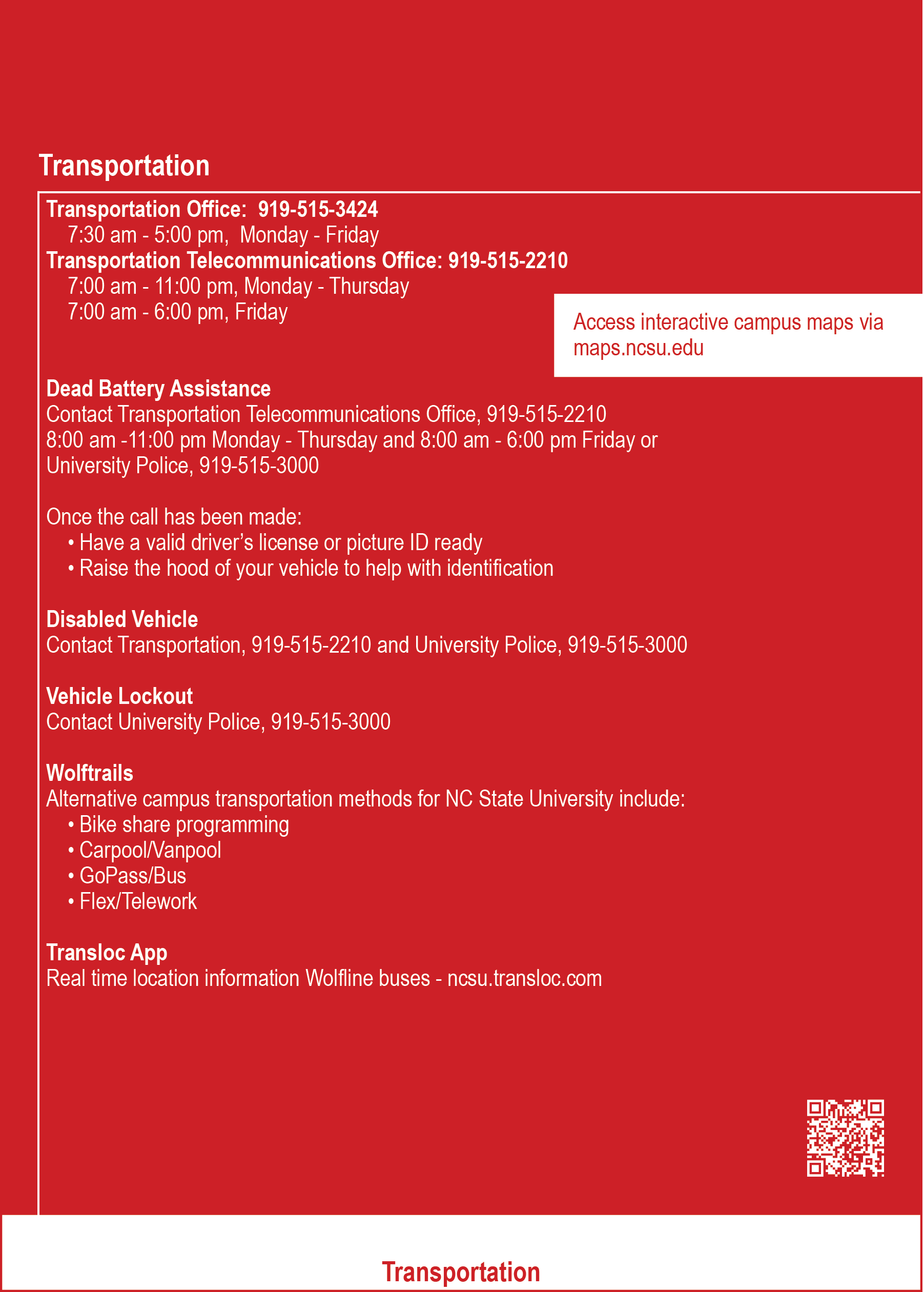
Transportation. Transportation Office: 9195153424. 7:30 am - 5:00 pm, Monday - Friday. Transportation Telecommunications Office: 9195152210. 7:00 am - 11:00 pm, Monday - Thursday. 7:00 am - 6:00 pm, Friday. Dead Battery Assistance; Contact Transportation Telecommunications Office, 9195152210 8:00 am-11:00 pm Monday - Thursday and 8:00 am - 6:00 pm Friday or University Police, 9195153000. Once the call has been made: Have a valid driver's license or picture ID ready, Raise the hood of your vehicle to help with identification. Disabled Vehicle; Contact Transportation, 9195152210 and University Police, 9195153000. Vehicle Lockout; Contact University Police, 9195153000. Wolftrails; Alternative campus transportation methods for NC State University include: Bike share programming, Carpool/Vanpool, GoPass/Bus, Flex/Telework. Transloc App; Real time location information Wolfline buses - ncsu.transloc.com. Access interactive campus maps via maps.ncsu.edu

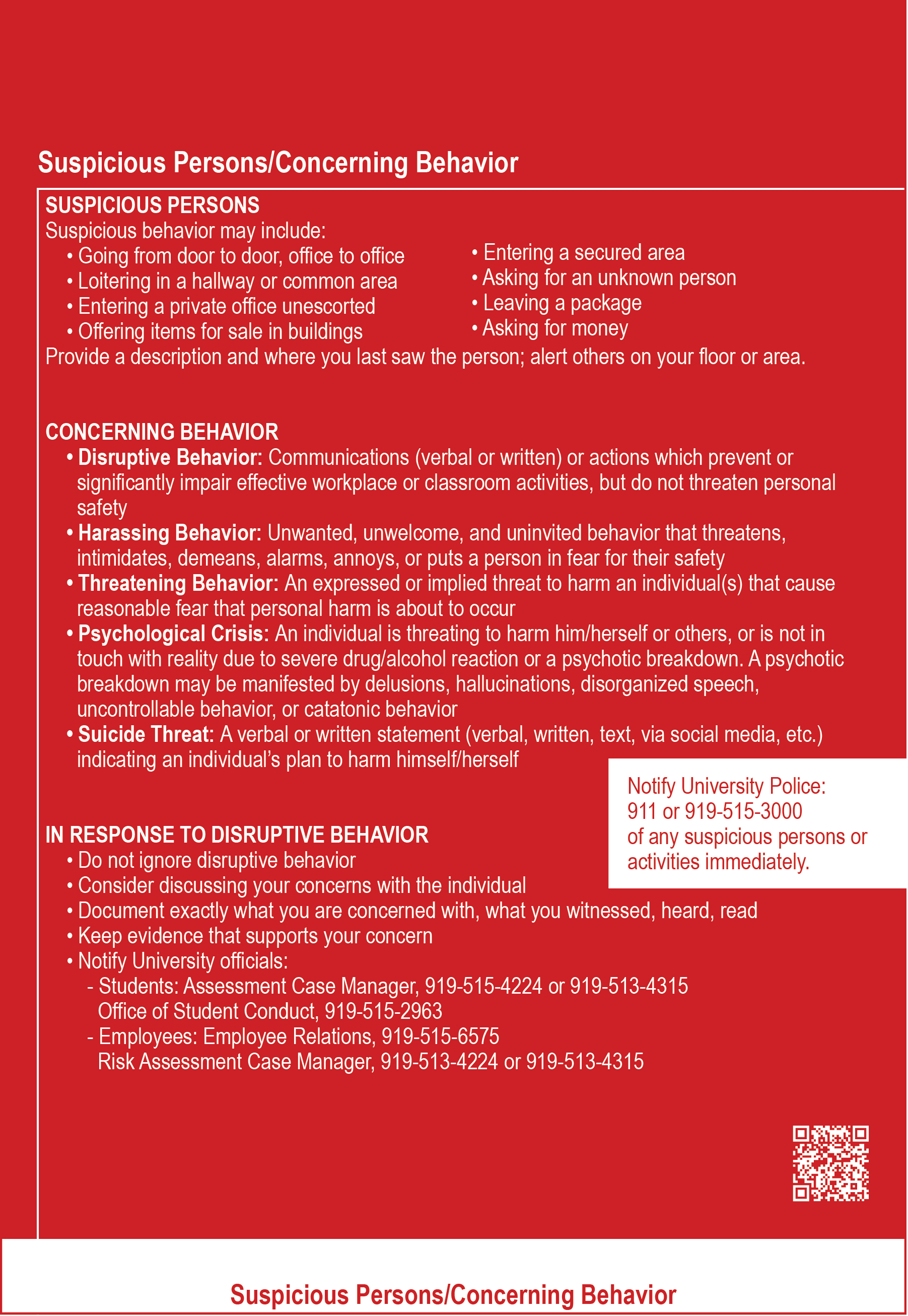
Suspicious Persons/Concerning Behavior. SUSPICIOUS PERSONS; Suspicious behavior may include: Going from door to door, office to office; Loitering in a hallway or common area; Entering a private office unescorted; Offering items for sale in buildings; Entering a secured area; Asking for an unknown person; Leaving a package; Asking for money. Provide a description and where you last saw the person; alert others on your floor or area. CONCERNING BEHAVIOR; Disruptive Behavior: Communications (verbal or written) or actions which prevent or significantly impair effective workplace or classroom activities, but do not threaten personal safety. Harassing Behavior: Unwanted, unwelcome, and uninvited behavior that threatens, intimidates, demeans, alarms, annoys, or puts a person in fear for their safety. Threatening Behavior: An expressed or implied threat to harm an individual(s) that cause reasonable fear that personal harm is about to occur. Psychological Crisis: An individual is threating to harm him/herself or others, or is not in touch with reality due to severe drug/alcohol reaction or a psychotic breakdown. A psychotic breakdown may be manifested by delusions, hallucinations, disorganized speech, uncontrollable behavior, or catatonic behavior. Suicide Threat: A verbal or written statement (verbal, written, text, via social media, etc.) indicating an individual's plan to harm himself/herself. IN RESPONSE TO DISRUPTIVE BEHAVIOR; Do not ignore disruptive behavior; Consider discussing your concerns with the individual; Document exactly what you are concerned with, what you witnessed, heard, read; Keep evidence that supports your concern; Notify University officials: Students: Assessment Case Manager, 9195154224 ог 9195134315. Office of Student Conduct, 9195152963. Employees: Employee Relations, 9195156575. Risk Assessment Case Manager, 9195134224 ог 9195134315. Notify University Police: 911 ог 9195153000 of any suspicious persons or activities immediately.