
Month One: What to do in the case of an EMERGENCY?

Emergency Management and Mission Continuity have teamed up with New Student Programs and Student Government to bring you our first month of outreach within our Year of Partnerships. We feel that students should have access to emergency information at their fingertips. So, what should you do?  No better way to start than to welcome new students and faculty with a review of the basics – Be PACK Ready – pack a bag, make a plan, take action!  Emergency preparedness basics do not really change, but where you are and what you do – does! The preparedness mantra from FEMA is “Be Prepared, Not Scared.”  What do you need to thrive as a member of the Pack? Check out this infographic for the basics!
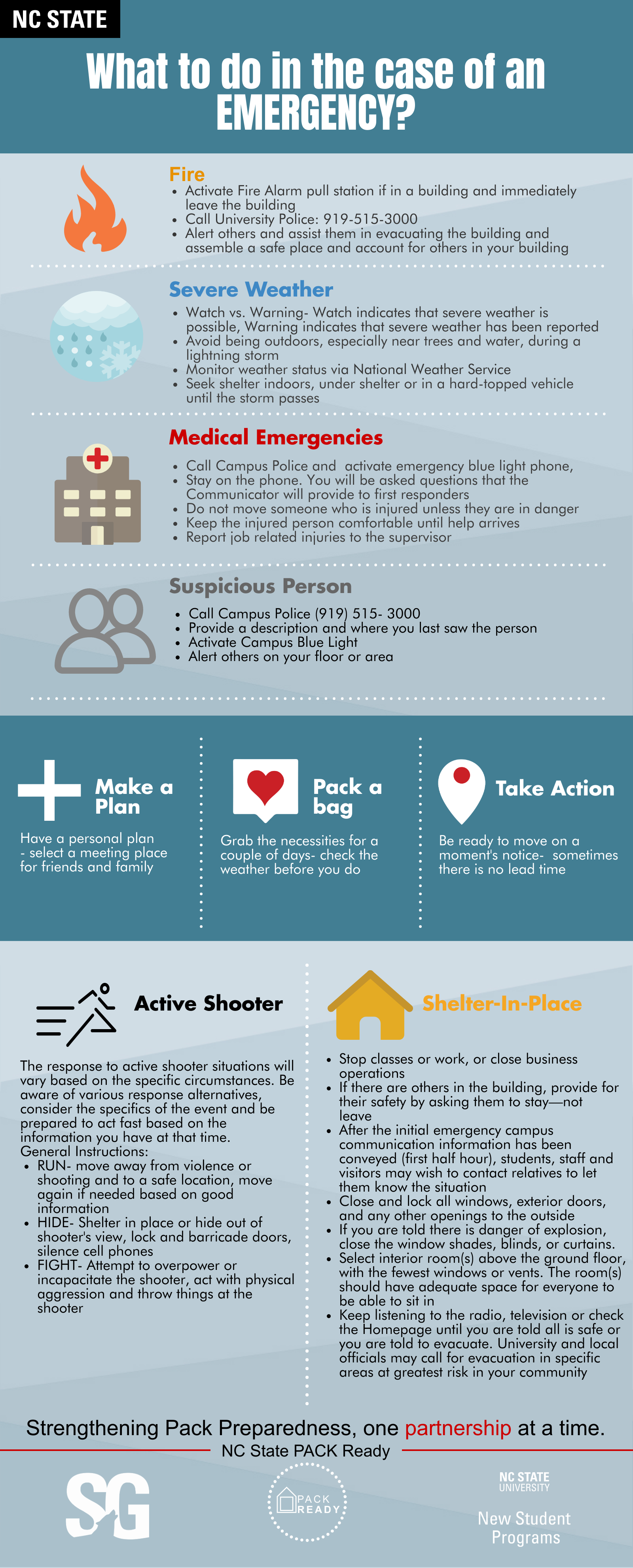


What to do in the case of an EMERGENCY?
Fire;
Activate Fire Alarm pull station if in a building and immediately leave the building.
Call University Police at 9195153000.
Alert others and assist them in evacuating the building and assemble a safe place and account for others in your building.
Severe Weather;
Watch vs. Warning; Watch indicates that severe weather is possible, Warning indicates that severe weather has been reported.
Avoid being outdoors, especially near trees and water, during a lightning storm.
Monitor weather status via National Weather Service.
Seek shelter indoors, under shelter or in a hard-topped vehicle until the storm passes.
Medical Emergencies;
Call Campus Police and activate emergency blue light phone,
Stay on the phone. You will be asked questions that the Communicator will provide to first responders.
Do not move someone who is injured unless they are in danger.
Keep the injured person comfortable until help arrives.
Report job related injuries to the supervisor.
Suspicious Person;
Call Campus Police at 9195153000.
Provide a description and where you last saw the person.
Activate Campus Blue Light.
Alert others on your floor or area.
Active Shooter;
The response to active shooter situations will vary based on the specific circumstances. Be aware of various response alternatives, consider the specifics of the event and be prepared to act fast based on the information you have at that time.
General Instructions:
RUN, move away from violence or shooting and to a safe location, move again if needed based on good information.
HIDE, Shelter in place or hide out of shooter's view, lack and barricade doors, silence cell phones.
FIGHT, Attempt to overpower or incapacitate the shooter, act with physical aggression and throw things at the shooter.
Shelter-in-Place:
Stop classes or work, or close business operations.
If there are others in the building, provide for their safety by asking them to stay, not leave.
After the initial emergency campus communication information has been conveyed (first half hour), students, staff and visitors may wish to contact relatives to let them know the situation.
Close and lock all windows, exterior doors and any other openings to the outside.
If you are told there is danger of explosion, close the window shades, blinds, or curtains.
Select interior rooms above the ground floor, with the fewest windows or vents. The rooms should have adequate space for everyone to be able to sit in.
Keep listening to the radio, television or check the Homepage until you are told all is safe or you are told to evacuate. University and local officials may call for evacuation in specific areas of greatest risk in your community.
General;
Make a plan, have a personal plan and select a meeting place for friends and family. Pack a bag, grab the necessities for a couple of days and check the weather before you do. Take action, be ready to move on a moment's notice, sometimes there is no lead time.